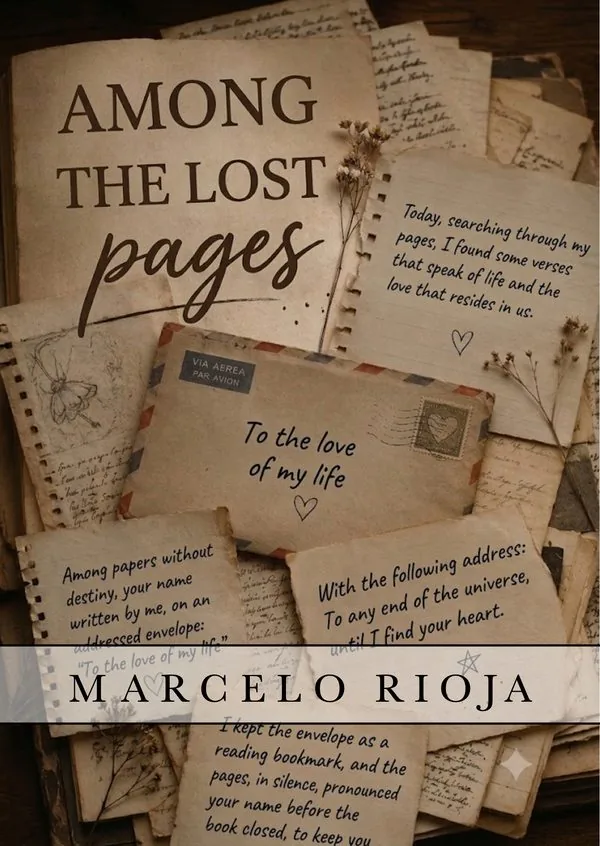



Literary review
About the book
There are books you read and books you hear with your chest. Among the Lost Pages clearly belongs to the second category. From the preface on, Marcelo Rioja is honest about what the reader will find: not a collection built on artifice, but a set of verses born as real messages, addressed to a real person, written at different times and in different places yet united by a single heartbeat.
And that is, perhaps, the book's greatest virtue: its lack of pose. The dedication — addressed to "Marilyn," the thread running through the whole work — already sets the tone: that of someone who writes not to show off, but because he needs to say something that would otherwise stay unspoken. That sincerity holds poem after poem, without falling into solemnity or excess.
An emotional map of love
The collection is organized as a journey: it begins with the encounter and the wonder, moves through distance and waiting, and also pauses on other loves — children, mothers, grandparents — before closing with an epilogue that works almost like a final letter to the reader. That breadth gives the book more texture than a conventional romantic collection promises.
One of its most accomplished devices is the constant use of cosmic and natural images — the wind, the moon, the cosmos, the tides — as interlocutors of the poetic voice. In the poem that opens the book, Rioja asks the wind, the sun and the moon what love is, and each answers in its own way, until the universe itself "pronounces" the name of the beloved.
Style and tone
The writing is direct, in free verse, without unnecessary ornament. Rioja does not look for the far-fetched metaphor or the formal game: he looks for emotional clarity, and for the most part he finds it. It is a style that favors closeness over technical sophistication, which makes the book feel like an intimate conversation rather than a literary exercise.
What remains when you close the book
As the author's own synopsis sums it up, this is a book written with heartbeats rather than ink. And that phrase describes the reading experience well: Among the Lost Pages does not impress through formal ambition, but through its honesty. It is a collection to read slowly, ideal for those who enjoy confessional poetry and books that document a real love story, with names and dates that beat behind every verse.
A second look
There are books you read with your eyes. Others, with your soul. Among the Lost Pages belongs to this second category. Marcelo Rioja gives us a collection that does not seek to dazzle with rhetorical artifice, but to move from the most intimate truth. Each poem is an open window onto his inner universe: a space where love, distance, fatherhood and faith intertwine with the immensity of the cosmos.
A sincere voice that crosses time
The greatest strength of this book is its emotional honesty. Rioja writes without masks, in a voice that feels close, almost confessional. There is no poetic pose; there is, instead, a man who writes to name what he feels, to inhabit absence and to celebrate the encounter.
The poems dedicated to his wife Marilyn are the backbone of the book. From "Since I Saw You" — where he reconstructs the chance childhood encounter that returns forty years later — to "To Love," where love is defined as an enigma that finds its answer in her, the reader takes part in a sentimental journey spanning decades. Rioja manages to convey the depth of a love that has matured over time yet keeps the freshness of the first instant.
The universe as a metaphor for love
One of the collection's most original hallmarks is its cosmic imagery. Rioja does not write about love only from the earth; he places it in orbits, comets, constellations and quantum pulses. Poems such as "Too Close to You" (with its reference to the Schwarzschild radius), "The Cosmos, Today" or "Comet" — where he writes a name on the tail of a comet that will return in fifty thousand years — reveal a poet who looks at the sky to understand what he feels on earth.
This fusion of science and tenderness is one of the book's most notable achievements. Rioja turns physics into poetry without scientific rigor dimming the emotion; on the contrary, it amplifies it. Love becomes gravitational force, quantum leap, sinusoidal signal. That original gaze gives the collection a voice of its own within contemporary poetry.
A father's love: the other great heartbeat
If romantic love is the guiding thread, filial love is the counterpoint that humanizes the book and anchors it to the earth. The poems dedicated to his sons — Leonardo and Alecito — are perhaps the most moving of the collection. In them, the poet's voice becomes more vulnerable, more protective, more aware of the passing of time.
"On This Stretch of the Path" and "And Soon I Will Have to Go" capture the duality of a father who watches his children grow and, at the same time, still sees them as little ones. The image of a father who becomes a child when he is with them ("When you are with me, I become a child") is disarmingly tender. Rioja conveys the quiet pride, the constant worry and the deep joy of fatherhood without falling into easy sentimentality.
Distance as poetic territory
Absence is another major theme of the book. Rioja writes from distance — geographic, emotional, temporal — and turns it into a space for creation. Poems such as "Today, While You Are Far Away," "This Celestial Vault" or "Behind the Window" explore that geography of missing each other with a sensitivity that avoids drama to find beauty in waiting.
The poet does not mourn the distance; he inhabits it. He writes to it, names it, turns it into a bridge. And in that act, absence becomes presence: the echo that repeats "I love you" among the hills, the star that does not twinkle in the night, the Morse message that the wind finally delivers.
Style: simplicity without poverty
Rioja's style is direct, colloquial, intimate. There is no grandiloquence or far-fetched metaphor. His poetry is built from the truth of feeling and the clarity of the image. That does not mean it is simple: there is careful work on pulse, rhythm and word choice that reveals a poet who knows what he wants to say.
The repetition of certain themes — light, the cosmos, hands, the heartbeat — never grows tiresome because each poem adds a nuance, a new perspective. That thematic insistence is, in fact, the constancy of love: the same heartbeat that repeats but is never the same.
A book that invites a pause
Among the Lost Pages is not a book to read in one sitting. It is a book to inhabit: to open at a random page, to read aloud, to linger on a verse that resonates with your own life. Rioja achieves something difficult: the reader not only understands what he feels but recognizes themselves in those feelings.
The epilogue puts it clearly: "The love that sustains them is not exhausted in the verses; it expands beyond them, like the echo of a comet continuing its journey through the cosmos." And it is right. This collection transcends its pages because it speaks of something universal: the need to love and to be loved.
Conclusion
Among the Lost Pages is a collection that honors love in all its forms: the love of a couple that defies time, the love of a father that becomes tenderness, the filial love that gives thanks, and the love of God that is expressed as faith. Marcelo Rioja writes from lived experience, without filters or masks, and makes the reader feel like an accomplice in his journey.
It is a book for those who believe love is written in the heart, for those who look at the stars searching for a name, for those who know that, even among the lost pages, love always finds whoever will read it.
★★★★☆ (4.5/5) — Recommended for lovers of contemporary poetry with a cosmic sensibility, readers looking for poems about love, fatherhood and distance, and anyone who believes science and poetry can speak in harmony.