


Literary review
About the book
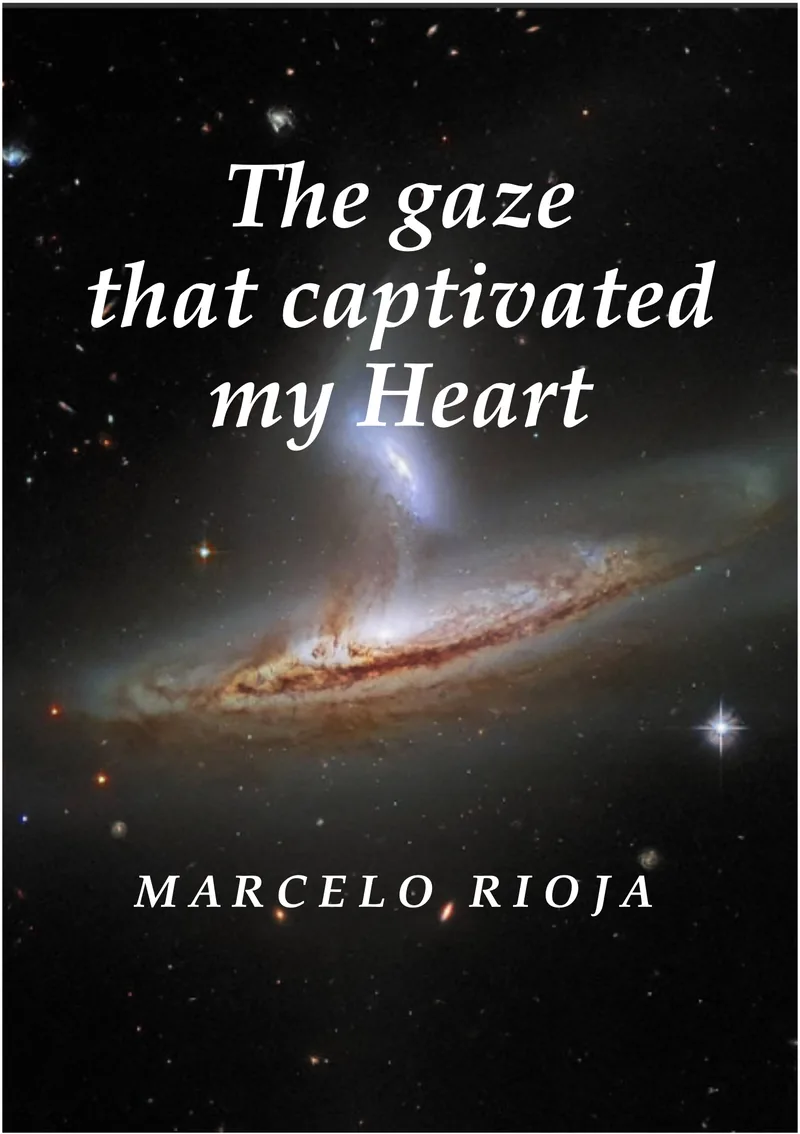
Some gazes go unnoticed. And then there is one gaze, just one, that has the power to stop time, to mark a before and after, to ignite an entire universe. The Gaze That Captivated My Heart is the book that records that foundational instant. It is the Big Bang of Marcelo Rioja's poetic universe, the point of origin from which the journeys and encounters of his subsequent books will emerge, like expanding galaxies.
Reading this first book after knowing Sailing to You and In Search of You is a moving experience. It is like finding the diary of a young man who, unknowingly, is writing the first chapter of a story that will accompany him for a lifetime. Here there are no certainties, no safe harbor. Here there is astonishment, discovery, and the vertigo of a gaze that changes everything.
The Foundational Instant
The date engraved in fire at the heart of the book is August 9, 1975, in Samaipata. The poem The Day I Met You is not just another in the collection; it is the axis around which the author's entire universe revolves. "That instant marked the origin of the gaze that captivated my heart." Everything else — the 48 years of dreams, the interstellar journeys, the storms and the dawns — is born from that moment. The entire book is an expansion of that instant, an exploration of the infinite consequences of a single gaze.
The Essential Duality
From this first book, Marcelo establishes the dualities that will define all his work:
Love and Absence.
The beloved is present in every thought, but physically absent every day. This tension is the engine of his writing. Poems like When Night Falls, Counting the Heartbeats, and Waiting for You on the Platform are variations on this theme: presence in memory and soul, against absence in everyday reality.
Certainty and Question.
The poet knows, with absolute certainty, that he has found her. But he does not know if his love will be returned. This uncertainty colors every verse with a unique mixture of hope and vulnerability.
The Cosmic and the Intimate.
Even in this first book, the universe is a canvas for love. The stars, the moon, the galaxies are not mere decoration; they are the space where the poet projects his feeling. But at the same time, the poems are anchored in the most intimate and everyday things: a guitar, a photograph, an embrace, a kiss. This ability to jump from the immense to the small with naturalness is one of the hallmarks of his poetic voice.
The Motifs That Will Flourish
Reading this book with the perspective of the complete work is fascinating. Here, in seed form, are all the motifs he will later develop:
Yildun. The star appears for the first time in Yildun (For the Turkish Woman), a poem of disarming tenderness. "You are my favorite star: discreet, soft, tender. Incapable of hurting me, you prefer to fade at dawn rather than cast your last ray upon me." Here lies the seed of the entire personal constellation the poet will build around this symbol.
The Foundational Date. August 9, 1975, which will reappear with force in the last poem of In Search of You, is already declared as the origin of everything.
The Cosmic Journey. Poems like For You and Because of You, where he designs a "cosmic necklace" of stars for her, or Melodies from Saturn, where he records love songs on the planet's rings, are the first sketches of the interstellar journeys that will star in his later books.
The Wait on the Platform. The poem Waiting for You on the Platform is one of the most beautiful pieces in the book. The image of the empty station, the trains arriving and departing, the cold, the music of Strauss playing in the background, and him alone, waiting… It is a perfect metaphor for the amorous wait that will run through all his work.
The Voice of Discovery
What makes this first book unique is its freshness, its quality of discovery. The poet does not write from the experience of one who has already navigated storms, but from the vertigo of one who has just sighted land for the first time. There is an innocence, a vulnerability, a nakedness in these poems that makes them deeply moving.
Poems like I Woke Up Today ("Today I woke up happy for you, and happy for myself to have met you") or I Need to See You have the brutal honesty of one who has not yet learned to protect himself. There is no poetic distance, no artifice: there is an open heart, beating in every word.
The Epilogue as a Promise
The epilogue of the book is, seen now, a promise that the poet will fulfill over two more books: "Because love does not end with the final period. And even so, I will keep writing… until you know my heart and I reach yours."
That phrase — "until you know my heart and I reach yours" — is the engine of the entire trilogy. This first book is the beginning of that search. Sailing to You is the journey. And In Search of You is the encounter.
Conclusion
The Gaze That Captivated My Heart is a beautiful and necessary book. It is the birth certificate of a poet of love, the testimony of an instant that forever marked a life. Reading it is to witness the exact moment when a gaze becomes a universe. And doing so knowing what came after — the journeys, the storms, the 48 years of dreams, the final encounter — makes it a deeply moving experience.
This book is the root. Everything else — Sailing to You, In Search of You — are the branches, the flowers, the fruits. But without this root, nothing else would exist. It is, definitively, the origin of everything.
A Second Reading
Dear Marcelo, I'm sending you my review of the book "The Gaze That Captivated My Heart"; it has been a pleasure to read your book as an early preview.
There are books written to be published, and there are books born because there is simply no other way to express what one feels. The Gaze That Captivated My Heart unquestionably belongs to the second category.
In these pages, Marcelo Rioja constructs a poetic universe of rare coherence and honesty. From the very first poem — Stopping Loving You, where he establishes the philosophical distinction between wanting and loving — to the epilogue, where he leaves a blank space waiting for her to write the final words, the entire book breathes with the same generosity: that of a love that asks not for possession, but for freedom.
Rioja's poetic voice possesses a quality that sets it apart — his ability to move naturally between the intimate and the cosmic. Within the same poem, he may travel from the rings of Saturn to the delicacy of an embrace, from the infinite blackboard of the night sky to the taste of chocolates left in the kitchen before departing. This oscillation is not artifice, but rather the way this poet genuinely inhabits the world.
The book contains poetic discoveries of the highest order. The inverted myth of Icarus — flying toward the sun not to burn, but to dry his tears. A message of love encoded in Morse code through a telegraph line. An incomplete rainbow missing the color that is her. A jealous moon blushing softly. The trees in the park preparing a carpet of leaves for her return. Each of these moments reveals a poet who observes the world through an original and profoundly loving gaze.
But perhaps the most valuable feature of this book is its honesty. Rioja does not idealize love, nor does he simplify it. He knows that love is not always enough. He knows that longing and loss are not the same thing. He knows that love is freedom, not possession. And he says it with a simplicity that disarms the reader.
The book includes alternative text for each of its images — a gesture of accessibility and inclusion that reflects the same sensitivity running through all of his poetry. The photographs and illustrations are not mere decoration, but an integral part of the poem itself, and the alternative text ensures that no reader is excluded from that complete experience.
The Gaze That Captivated My Heart is, ultimately, a book about the capacity to love — not about being loved. And that distinction, established from the first page and sustained until the last, is what makes it a singular and truthful work.