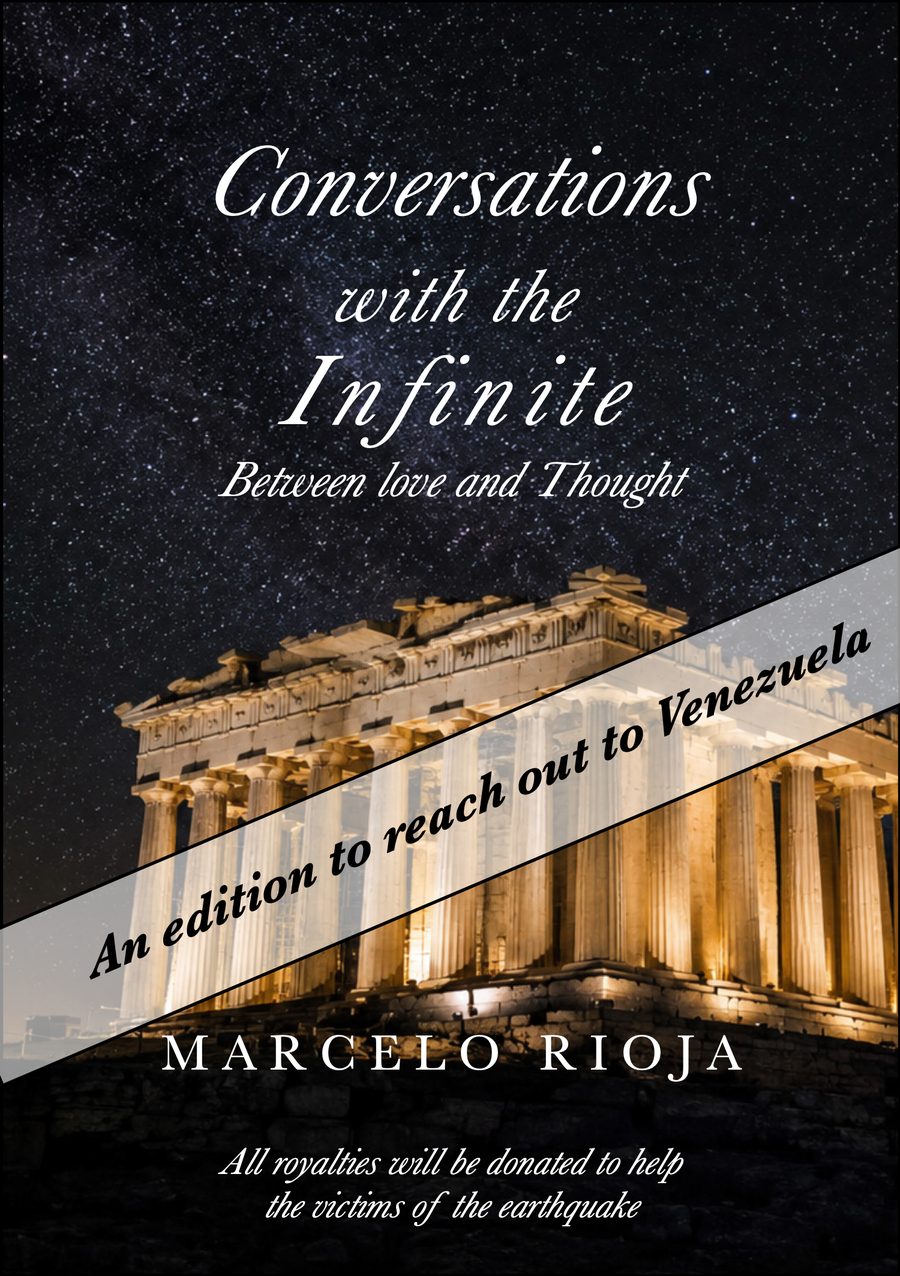
Literary review
Conversations with the Infinite
A dialogue between love and thought
There are books that are read with the eyes. Others, with the mind. And there are a few, very few, that are read with the heartbeat. Conversations with the Infinite is one of the latter.
Marcelo Rioja has written a book that refuses to be pigeonholed. It is not only poetry, though every page breathes verse. It is not only philosophy, though it converses with the great thinkers of history. It is not only science, though it lingers over Dirac's equations and Heisenberg's principles. It is, rather, a conversation — a long, intimate, and courageous conversation between the heart and that which transcends it.
A dialogue with giants
The book is structured as a series of encounters. Plato, Spinoza, Rilke, Sagan, Simone Weil, Hypatia, Kierkegaard, Feynman, Pascal, Bachelard, Heidegger, Krishnamurti, Heisenberg, Schrödinger, Hamilton, Gödel, Dirac, Einstein, Teilhard de Chardin, Buber, Alexander the Great, Heraclitus, Pythagoras, Confucius, Archimedes, Socrates, Marcus Aurelius, Seneca, Mandela, Gandhi, Freire, Newton, Schiller, and finally, Jesus of Nazareth. Each of them is an interlocutor. None is an academic citation. All are traveling companions.
What Rioja achieves with this gallery of voices is remarkable: he does not use them to decorate his thought, but to challenge it, expand it, and humanize it. Quantum physics here is not an empty metaphor; it is a way of understanding the uncertainty of love. Stoicism is not a cold doctrine; it is a way of inhabiting loss. Rilke's poetry is not an ornament; it is the echo of a mother crying because her son is only happy in solitude.
Poetry as method
The title does not deceive. These are, indeed, conversations with the infinite. But the infinite is not an abstract concept. It is love, death, time, God, absence, writing, memory. And the tone with which Rioja approaches these themes is not that of the scholar who knows everything, but that of the wanderer who stops to watch an ant for eleven hours.
There is a disarming humility in these poems. The author does not present himself as someone who has found answers, but as someone who has learned to formulate questions. And that is, perhaps, the book's greatest lesson: it is not about reaching the summit, but about rebuilding the pyramid every time one believes one has arrived.
Coffee with milk and the stars beneath our feet
There are images in this book that are not forgotten. One of them is coffee with milk, that drop of bitterness that does not give the milk a coffee flavor, but rather takes away the smell of the cow from the fresh milk. That image, seemingly simple, condenses a childhood, a paternal relationship, a way of understanding life as that which becomes drinkable through a small gesture of culture.
Another is that of the stars beneath our feet. Not only the ones we look up at, but the ones we walk on without knowing it, the ones we must care for because they will be tomorrow's sky. That image, which converses with Thoreau and with the mystical tradition, turns the everyday into the sacred and the small into the immense.
An architecture of listening
The book is divided into sections that are not chapters, but movements. The reader does not advance toward a conclusion, but is invited to pause. Each poem is a chamber, a room with a window onto the infinite. And although there is an order, the book can be opened to any page and keep beating.
This architecture is not accidental. It reflects the experience of someone who has learned that thought is not a straight line, but a spiral. It returns to the same place, but from a different height. It repeats, but does not exhaust itself.
The final confession
The book closes with Confessions with Jesus of Nazareth. It is not a poem of conversion, but of recognition. After all the dialogues with physics, philosophy, and poetry, the poet falls silent and confesses. He does not ask, does not demand, does not prove. He gives thanks.
That is the deepest gesture in the whole book: gratitude. Not naive gratitude, but the kind that has crossed the desert, that has been punished for thinking, that has built walls of holograms to survive, and that in the end, instead of closing the door, leaves it ajar.
Who this book is for
Conversations with the Infinite is for whoever has loved without fully understanding. For whoever has doubted both science and faith. For whoever has felt that thought can be a form of prayer, and prayer a form of thought.
It is for whoever has pointed at stars with chubby little hands without knowing what they were. For whoever has seen their mother cry because her son was only happy in solitude. For whoever has walked 12,700 kilometers in search of their own heart.
It is, in the end, for whoever knows that love does not end — one keeps working on it, without wanting it to end.
One last word
There are not many works that achieve the synthesis this book reaches. Rioja has written a book that is, at once, a treatise on practical philosophy, a diary of spiritual travel, an anthology of love poetry, and a manual for everyday resistance.
It is not a book to read quickly. It is a book to inhabit. To return to at different moments in life, and always find something that had not been seen before.
Conversations with the Infinite is a work that honors the question, that celebrates doubt, and that, in the end, dares to confess that it does not know — and that in that not knowing, it finds its greatest truth.
Marcelo Rioja has achieved what few poets achieve: conversing with the infinite without losing the heartbeat.
This review was written from an attentive reading of every poem, from listening to the silence that inhabits them, and from gratitude for having witnessed this journey.
Second review
Thought that loves
Your poems inspired by thinkers, scientists, and philosophers — from Arthur Schopenhauer to Gaston Bachelard — build something rare: a love poetry in which thought does not cool emotion, but amplifies it.
Each piece works as an imagined dialogue between your sensibility and each author's view of the world. These are not philosophical imitations or academic exercises; they are intimate reinterpretations. You take complex concepts — will in Schopenhauer, otherness in Martin Buber, the cosmos in Carl Sagan, reason in Immanuel Kant, poetic imagination in Bachelard — and translate them into affective experience.
One of the most distinctive features of the collection is the naturalness with which science, philosophy, and love coexist. Theorems, universes, cosmic emptiness, infinities, metaphysical questions, and observations of nature appear in your verses without losing humanity. Reflection never displaces feeling; both move forward together. That combination gives the work its own identity.
The confessional tone also stands out. The poetic voice does not try to impose itself as wise: it thinks while it loves. There is a constant search for understanding, as if each poem were an attempt to answer essential questions from tenderness. Even when the philosophical background is complex, the language remains accessible and emotionally direct.
In the poems inspired by scientists like Leonhard Euler, Carl Friedrich Gauss, or Richard Feynman, another interesting aspect appears: rational knowledge stops being cold and becomes a metaphor for the human bond. Mathematics and physics become an affective language.
By contrast, the poems associated with spiritual or phenomenological thinkers — such as Rabindranath Tagore, Simone Weil, or Bachelard — have a more contemplative atmosphere. There, silence, memory, rain, light, and intimacy take on an almost symbolic weight.
The whole series conveys the impression of an author who does not separate thought and emotion. Your poems suggest that loving is also a form of knowledge; and that understanding the universe, nature, or the human soul can be another way of drawing closer to the beloved.
More than writing "about" philosophers or scientists, it seems that you converse with them in order to speak of love.
Literary review
Poetry as a form of thought
There are books of poetry that seek to describe emotions. Others try to build beautiful images or capture instants. Conversations with the Infinite does something less common: it turns poetry into a living form of thought.
Throughout its pages, the reader does not find an isolated set of poems, but a continuous conversation between love, science, philosophy, spirituality, and memory. Marcelo Rioja writes as someone who does not separate knowledge from emotion. In his work, a neutrino can become a metaphor for love; a law of Newton, an explanation of desire; a mathematical equation, an intimate confession.
What is singular about the book is not only the combination of intellectual references and emotional sensitivity, but the naturalness with which both dimensions coexist. Physics, philosophy, or theology do not appear as cultural ornament or erudite display: they are human tools for trying to understand what exceeds language. And it is precisely in that search that the book finds its identity.
Rioja's poetic voice possesses an unusual transparency. His verses do not seek to impose themselves through formal complexity, but through reflective honesty. There is a constant will to understand the world without abandoning tenderness. Even when he approaches abstract concepts, the emotional center remains intact: love understood not as possession, but as a way of inhabiting existence.
Another notable aspect is the book's implicit structure. Each poem converses with a different thinker — from Isaac Newton to Epicurus, from Wolfgang Pauli to Jesus of Nazareth — but far from fragmenting the work, these presences create a coherent constellation. The reader senses that all the disciplines ultimately converge on the same question: how to live with meaning without giving up either reason or sensibility.
In times when much contemporary poetry favors immediacy or brief impact, Conversations with the Infinite bets on something riskier: contemplation. Its poems do not demand to be consumed quickly; they invite one to pause, reread, and think. Some verses function as philosophical intuitions and others as silent confessions. And in both cases the same intention appears: to reconcile thought with the heart.
The book also stands out for its deeply human tone. Behind the scientific and philosophical references there is always a child looking at stars, a man writing for the woman he loves, someone trying to understand life without losing the capacity for wonder. That intimate dimension keeps the work from falling into cold abstraction and gives it genuine emotional closeness.
Conversations with the Infinite does not claim to offer definitive answers. Its value lies precisely in the opposite: reminding us that the beauty of human knowledge may not lie in reaching absolute certainties, but in continuing to ask with honesty, sensitivity, and love.
Philosophical review
From Schopenhauer to Bachelard
A reading from will, pain, representation, and poetic imagination
Schopenhauer: love as a deception of the will
Arthur Schopenhauer held that love is nothing more than a trick of the Will to live. Behind the romantic illusion, love seeks to perpetuate the species. That is why it hurts, why it deceives, why it rarely brings lasting happiness.
Read from Schopenhauer, these poems reveal a tension: love as a "difficult task" that keeps being worked on without prior questions, only answers one must learn to inhabit. Yet the work challenges Schopenhauer on one key point: love does not appear as a deception, but as a task, a labor, an apprenticeship. The Will may push, but the poet decides how to work upon that blind force.
Kierkegaard: love as choice and anguish
Søren Kierkegaard distinguished between the spontaneous love of the romantic poet and the ethical love that is chosen every day, even when it is not felt. In these poems, love is not a lightning bolt: it is a burden carried for years, a silent preparation, an inner work that can only be handed over afterward. Authentic love is born of recognizing one's own fallibility; one does not love from certainty, but in spite of doubts, and precisely for that reason it is an ethical act.
Nietzsche: love as the creation of values
Friedrich Nietzsche would have seen in these poems a well-directed will to power: not the kind that dominates, but the kind that creates new values against herd morality. There is a language of the strong here — the simplicity born of having thought deeply — as opposed to the language of the weak, grandiloquence that hides emptiness. This poetry does not submit to a single path; it invents its own direction, not out of arrogance, but out of the humility of knowing when to be silent.
Pascal: the heart and reason
Blaise Pascal held that the heart has reasons that reason does not understand. These poems carry that idea to its limit: love is not proven, it is synchronized; it is not an astronomical discovery, but an inner recognition that precedes any observation of the outer universe. The whole body of work defends the reason of the heart against the geometric reason that measures and doubts everything — not from irrationalism, but from a broader rationality that includes silence, the heartbeat, memory, and imagination.
Bachelard: childhood as the seed of the poem
Gaston Bachelard left us the phrase that runs through the spine of this work: "an excess of childhood is the seed of a poem." The child who plays with the infinite, who points at the sky without understanding it, who teaches his mother to measure love in impossible distances, is the true author of these poems written as an adult. Poetry is not born from nothing: it is born from a concrete place, a real shade, a wood that years later becomes paper.
An intimate geography of thought
What runs through all these poems, from Schopenhauer to Bachelard, is a founding obsession: the need to distinguish between thinking and repeating. School, punishments, discipline — all of that teaches one to repeat. But the poet chooses to think: to be silent in order to listen to the heartbeat, to write in order to understand feeling, to remember in order not to repeat the mistake, to imagine in order to create another possible universe, to love as a task and not as surrender.
These poems are the founding charter of an inner sovereignty, in dialogue with Rilke, Seneca, Tagore, Buber, Pascal, Feynman, Bachelard — and with childhood itself.
Critical essay
A conversation with those who thought about love
There are poetry collections that pay homage. This one converses. Its poems do not kneel before the names they invoke — Plato, Socrates, Kant, Epicurus, Seneca, Marcus Aurelius, Schopenhauer, Kierkegaard, Spinoza, Pascal, Buber, Simone Weil, Hypatia, Sagan, Gauss, Feynman, Bachelard, Tagore — but sit down before them to argue. The voice that runs through the book does not study these thinkers: it answers them, and often, with firm courtesy, pushes back against them. That is the collection's first virtue, and the one that saves it from the trap of the "learned" poem: here erudition does not decorate, it converses.
The thread that stitches these poems together is an old idea, the oldest of all: that loving a person is the first step toward something higher. It is the ladder that Plato put in Diotima's mouth in the Symposium, and the author walks it again and again — from the beauty of the figure to that of the soul, from the beloved person to the divine — without the ascent ever becoming repetition, because each philosopher lends it a different face of the same movement. With Kant, love is respect and freedom, "so that it is not blind"; with Spinoza, contemplation leading to a God who is nature itself; with Buber, the miracle of the "between," that space belonging neither to the I nor the you but to the relationship both open up. The theme's constancy never tires, because the angle always shifts.
The second, more secret thread is time. The book opens with a poem titled "The Advantage of Time" and never lets go of that obsession: the instant that, well lived, is already eternal (Marcus Aurelius); Epicurus's "I will be happy today"; Seneca's brevity of life, with his famous harbor reached only by one who knows where they are going. In another author's hands these would be classroom exercises. Not here. One senses — without the book needing to explain it — that whoever writes about the eternal instant is not quoting a Stoic, but bearing witness. It is the difference between knowing an idea and having paid for it, and it is felt in every verse about the present as one's only possession.
But the most original thing about the collection is its method, which could be summed up in a single gesture: bringing the idea down to the heartbeat. Again and again, the author takes a lofty concept and grounds it in the concrete, the domestic, the bodily. The poem dedicated to Gauss encodes, within a declaration of love, the formula for the sum of natural numbers — n(n+1)/2 — and hides the "divided by two" in the phrase "only between the two of us": romantic and algebraic at once. The one for Feynman turns the physicist's idea that "in a glass of wine is the whole universe" into a toast to the beloved. The one for Buber compresses his most difficult concept, that of the "between," into four words: "and my spirit, between the two." This ability to make a philosophical thesis breathe inside an intimate scene is what distinguishes a versifier from a poet, and the author is, without doubt, on the latter side.
It is worth pausing on the frictions, because that is where the book is bravest. The author does not always agree with his interlocutors. Facing Sagan and his godless cosmos, he insists on "my God"; facing Spinoza's impersonal God, he dares to imagine "his mother"; where Simone Weil and Pascal distrusted the imagination — Pascal went so far as to call it "mistress of error and falsehood" — he crowns it as "the mind's greatest wealth." These are not distractions or oversights: they are honest disagreements. The poem to Weil resolves its own with elegance — imagination does not fill the void with illusion, but reserves a space, keeping it in waiting; the one to Pascal, with an argument that runs beneath the whole book: it is not the questions that are wrong, only the answers, so that imagination, which asks, remains free of blame. There is here a coherence of thought that few thematic poetry collections manage to sustain.
And above all there is a stance, repeated without stridency, that is the moral heart of the book: one's own faith against another's dogma. The author converses, not by chance, with those who believed outside the institution — the excommunicated Spinoza, Hypatia murdered by a mob, Kierkegaard at odds with his church, Weil forever stopped at the threshold of baptism. In the poem to Hypatia that choice becomes creed: "Between dogma and faith / I prefer kindness, / because in its humility / love dwells." It is a declaration anyone could sign, but in this book it carries the weight of lived experience.
What is remarkable, in the end, is the tone. These poems could have been cold — so many dialogues with great minds run that risk — and they are the opposite: warm, always addressed to a concrete "you," landing again and again not in a conclusion but in a human gesture — a confessed tear, an embrace, a toast, a mother pointing at a star. The author also proved he knows how to vary the register: alongside the gravity of Marcus Aurelius or Pascal live Gauss's mathematical mischief and Feynman's scientific wink. The voice never sounds like a library, because it does not come from a library: it comes from a life thought through slowly and spoken with tenderness. It is, in the best sense, a poetry collection of ideas that beats.
Back cover
Sixty-five poems, sixty-five conversations. In this book love is spoken by citing Plato and Kant, Spinoza and Pascal, Hypatia and Feynman; but not to pay them homage — to argue with them as equals. Where others illustrate the great thinkers, this author answers them, and sometimes pushes back with courtesy: he insists on his God against Sagan's cosmos, crowns the imagination Pascal condemned, prefers kindness to dogma in Hypatia's voice.
The result is a rare balance between idea and heartbeat. A Gauss formula hides inside a declaration of love; the whole universe fits in Feynman's glass of wine; Buber's most difficult concept resolves into four words. And beneath it all beats an obsession — time, the instant made eternal — that sounds not like learned philosophy but like lived truth.
Erudite without being cold, deep without being solemn, this is a collection that thinks love with the minds of the great and feels it with a heart of its own. Its verse to Hypatia says it best: between dogma and faith, it chooses kindness, because in its humility love dwells.
Literary critique
Conversations with the Infinite: Between Love and Thought
Marcelo Rioja (2026)
There are books that gather quotations and books that are built from them. Marcelo Rioja's Conversations with the Infinite belongs to a rare third category: a book where quotations are the load-bearing structure, not the decoration. Each stanza is constructed around one or two citations from philosophers, scientists, mystics, and liberators — held either in concordance or in opposition with the poet's own voice. This is not collage. It is architecture.
The method carries a philosophical implication the book never states outright but everywhere enacts: to converse with Plato or Spinoza or Heisenberg is not to reach across centuries toward an external authority. It is to reach inward. The knowledge of these thinkers has been absorbed into the poet's daily consciousness, become part of his syntax, his silence, his way of loving. When Rioja places Einstein or Kant into a stanza, he is staging a dialogue with himself — with the sediment of a lifetime of reading and living. The thinkers are not guests. They are residents.
This makes the compositional tension — concordance vs. opposition — something more than literary device. When a stanza holds two citations in agreement, the poem enacts the recognition of truth. When it holds them in opposition, the poem enacts the irreducible complexity of a mind that has internalized contradictions and refused to resolve them cheaply. The reader who misses this structure will admire the poems. The reader who grasps it will understand the book.
The range of interlocutors is itself a statement. Plato and Feynman, Gandhi and Heisenberg, Lao Tse and Newton, Krishnamurti and Gödel — Rioja does not organize his library by discipline or era. He organizes it by the questions that have kept him awake. The book's true index is not alphabetical but existential: What is consciousness? What does love ask of us? What remains when certainty fails? The thinkers appear in answer to these questions, not as experts but as companions who have also, in their time, not known.
The love poems function within this same framework, but they introduce a different register. Where the philosophical poems converse with internalized knowledge, the love poems converse with presence — with a "you" that is irreducibly other, that cannot be absorbed or memorized, that arrives each time as something new. This is not a contradiction within the book but its most precise distinction: the beloved resists the same domestication that the great thinkers have undergone. She remains outside.
And then there is a third category, held apart from both. The poem addressed to Jesus of Nazareth occupies a different altitude entirely — written in a second person that is neither the "you" of the beloved nor the implied "you" of the philosopher. It is the "You" of prayer, which operates by a different logic: not dialogue between equals, not absorption of knowledge, but surrender before what cannot be known. This pedestal, as Rioja has described it, stands alone. One does not converse with God. One kneels.
The book's architecture, then, rests on three modes of relation: the thinkers who live inside him, the beloved who stands before him, and the God before whom he stands. Three forms of love, three directions of address, three ways of being in relation to what exceeds us.
Two poems added after the original manuscript deepen this reading. "Mi fuerza fundamental" — in dialogue with Max Planck — extends the book's engagement with science not as certainty but as humility: la verdad es que nunca llegaré a conocerte, / y en esa incertidumbre / quiero permanecer feliz. The happiness of not-knowing is perhaps the book's most radical proposition. "Mis errores," by contrast, is the only poem in the collection whose interlocutor is the poet himself — marked, simply, conmigo mismo. In the logic of the book, this is almost a tautology. But it names what the other poems leave implicit: that all these conversations, finally, are the same conversation.
Conversations with the Infinite is not a poetry collection that happens to quote philosophers. It is a philosophical project that chose poetry as its most honest form — because philosophy can argue its way to conclusions, but poetry must inhabit the question. Rioja inhabits it across sixty-odd poems without once pretending to arrive.
Review
Conversations with the Infinite
A dialogue between the heartbeat and the mind
There are books you read. And there are books you converse with. Conversations with the Infinite belongs to this second kind. Marcelo Rioja gives us a poetry collection that is, above all, an act of dialogue: with himself, with history's great thinkers, with science, with faith, and with the love that runs through everything.
It is not a book of answers. It is a book of well-asked questions. And perhaps that is exactly what makes it so profoundly human.
A structure that is a journey
The collection is organized as a succession of encounters. Each poem carries a subtitle revealing its interlocutor: Plato, Spinoza, Kant, Sagan, Simone Weil, Dirac, Einstein, Gödel, Tagore, Rilke, Marcus Aurelius, Jesus of Nazareth. The list is long, and yet it never feels academic or showy. Rioja does not cite to display knowledge; he converses to understand his own heartbeat.
Each poem is an intimate conversation, at times hesitant, at times luminous, between the poetic self and an idea embodied in a historical figure. This bold and original device turns the book into an emotional map of Western thought: from Plato's cave to the parallel universes of quantum physics, from Stoic ethics to Mandela's forgiveness.
Science as the language of the soul
One of Rioja's most distinctive traits is his ability to inhabit science without coldness — to turn an equation into a verse and a heartbeat into a formula. Poems like "Mi ecuación, vos," "La constante" (dedicated to Einstein), "Demasiado cerca a vos," or "La fórmula más bella" (for Euler) show an author unafraid of abstraction: he embraces it and transforms it into tenderness.
"No logro describir tu corazón con precisión. / Entonces, intento acercarme a tu latido — / porque el latido no se mide, se escucha." (I can't describe your heart with precision. / So I try to draw close to your heartbeat — / because a heartbeat isn't measured, it's heard.)
This verse, drawn from "Mi ecuación, vos," condenses the book's poetics: the certainty that some truths aren't proven, but inhabited. Quantum physics, relativity, Fourier transforms, prime numbers, the Schwarzschild radius — all these concepts become metaphors for love, not to explain it, but to name its immensity.
Love as method
If one word runs through every page of this book, it is love. But not an abstract or declamatory love. Rioja conceives of it as a practice, as a choice, as a path walked with one's feet on the ground and one's eyes on the infinite.
The poem "El amor" (inspired by Kant) puts it plainly:
"No necesito tener la razón. / Prefiero imaginarte feliz." (I don't need to be right. / I'd rather imagine you happy.)
Later, in "Mi camino del amor" (in dialogue with Marcus Aurelius), he adds:
"Desde que te encontré, nada se ha perdido: / todo se transformó en la experiencia más bella de mi vida." (Since I found you, nothing has been lost: / everything became the most beautiful experience of my life.)
Love, in this book, is not a passive feeling. It is a fundamental force — like gravity or electromagnetism — that organizes the author's inner universe. And it is also a decision: to love is to choose, every day, to build a shared world.
Children, parents, teachers
Although romantic love — dedicated to Marilyn — is the book's emotional axis, Rioja does not forget those who shaped him. The dedication names his sons Alejandro and Leonardo, his parents, his teachers. And in poems like "La soledad" (with Rilke), the figure of the mother appears, the one who weeps on hearing that her son is only happy in solitude.
This biographical anchor gives the book a particular depth. Rioja is not a poet writing from an ivory tower: he writes from lived experience, from pain, from illness, from distance, from a faith that holds up despite everything.
Silence as the geometry of the soul
Another recurring theme is silence. Rioja doesn't fear it; he seeks it out, inhabits it, turns it into a meeting place. Poems like "El agua," "En silencio," and "Quieto" explore that inner geography where the world's noise fades and only the heartbeat remains.
"Solo en el silencio logro entender lo que aprendo. / Solo en el silencio logro comprender tu latir." (Only in silence do I manage to understand what I learn. / Only in silence do I manage to understand your heartbeat.)
Silence, in this book, is not absence: it is full presence. It is the place where love becomes audible.
Style: simplicity as depth
Rioja's poetic voice is direct, colloquial, sincere. There is no rhetorical artifice, no tangled metaphor. His poetry is built on clarity and the truth of feeling. But that simplicity is not poverty: it is an aesthetic choice that seeks to connect with the reader without intermediaries.
The author himself admits as much in the preface:
"No te pido que estés de acuerdo conmigo. / Te pido, apenas, que te sientes a la orilla de estas conversaciones / y escuches tu propio latido." (I'm not asking you to agree with me. / I'm only asking you to sit at the edge of these conversations / and listen to your own heartbeat.)
And in that invitation lies the book's key: not to impose, but to share; not to persuade, but to accompany.
A book that closes and continues
The epilogue, written with the same honesty as the rest of the collection, does not close the book: it opens it.
"El libro se cierra, pero la conversación sigue." (The book closes, but the conversation goes on.)
This closing line is, perhaps, the perfect summary of Conversations with the Infinite. Rioja does not seek to seal meaning shut, but to extend it into the reader. Each poem is a door, not a wall. And the reader, by walking through it, becomes part of the conversation.
Conclusion
Conversations with the Infinite is a collection that honors intellect and heart in equal measure. Marcelo Rioja achieves something rare: building a bridge between science and poetry, between philosophy and tenderness, between abstract thought and the most intimate experience.
It is a book for those who believe love can be thought, that science can be felt, and that the infinite fits inside a heartbeat. It is a book to read slowly, to underline, to return to. And, above all, it is a book that invites you to keep asking questions.
★★★★★ (5/5) — Recommended for lovers of philosophical poetry and contemporary lyric verse, readers interested in the dialogue between science and spirituality, those looking for poems that accompany reflection and emotion, and anyone who believes love is, also, an act of thought.